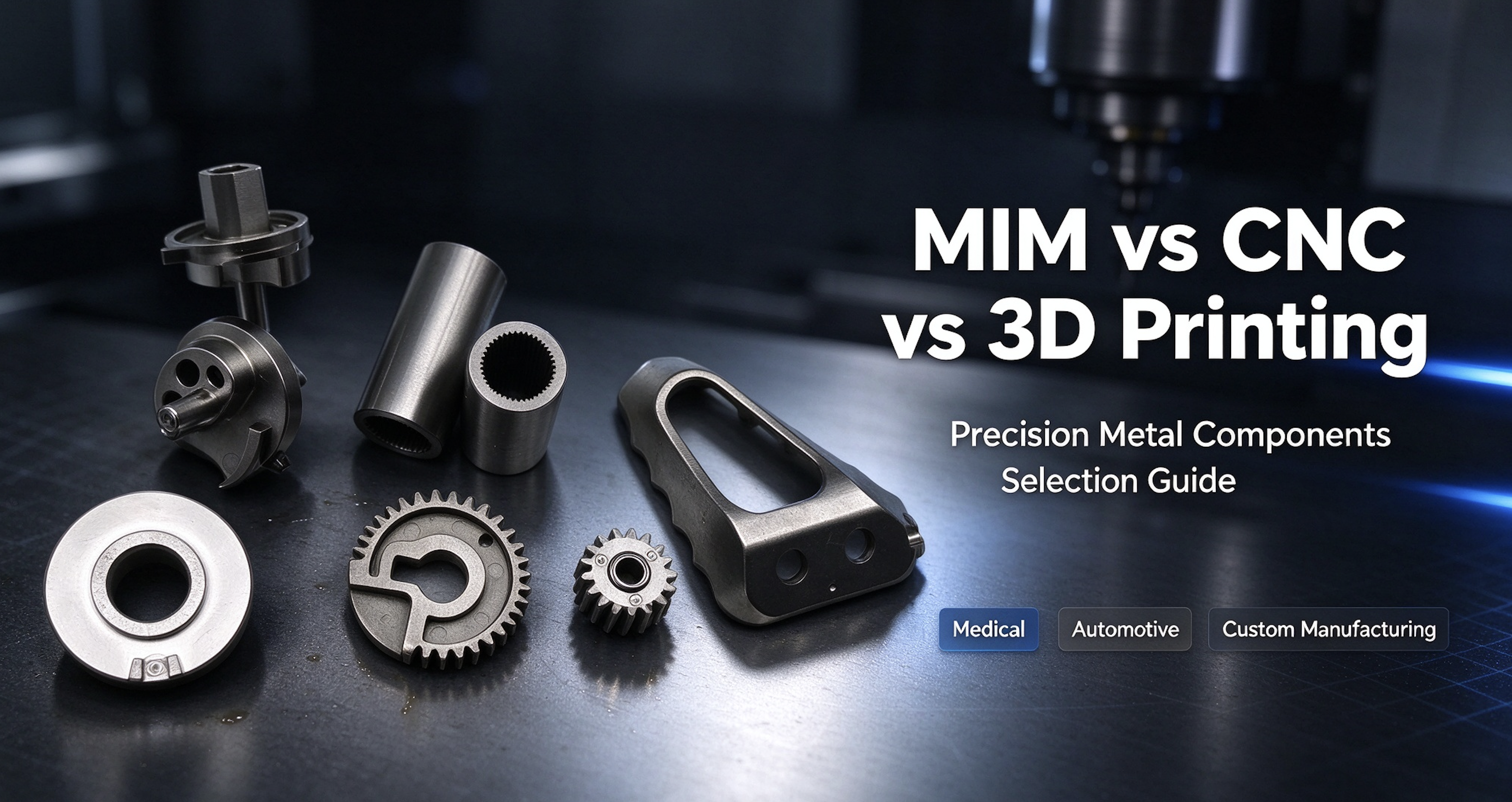
This professional manufacturing guide systematically compares three mainstream precision metal manufacturing technologies: MIM, CNC machining, and metal 3D printing. It analyzes their differences in dimensional tolerance, structural adaptability, production cost, lead time and applicable batch ranges, focusing on medical device and automotive precision component scenarios. Combined with real industry cases and a standardized 4-step selection framework, the article helps engineers and procurement buyers quickly select the most suitable manufacturing process for custom miniature and complex metal parts, while providing professional bridge production and mass production solutions to optimize project cost and delivery efficiency.
<h2 style="text-align: left;">1. Introduction</h2><p>Medical device and automotive precision metal components require strict dimensional tolerance, stable mechanical performance, high consistency, and cost-effective mass production capability. Engineers, product designers, and procurement buyers often face a core problem: <strong>which manufacturing process delivers the best balance of cost, precision, lead time, and batch stability for custom precision metal parts</strong>.</p><p>The three mainstream metal manufacturing technologies for high-precision metal components are <strong>MIM (Metal Injection Molding)</strong>, <strong>CNC Machining</strong>, and <strong>Metal 3D Printing</strong>. Each process has distinct advantages and applicable scenarios in terms of production volume, geometric complexity, tolerance accuracy, and unit cost.</p><p>This article delivers a structured, actionable process selection guide for medical and automotive precision metal parts, helping engineers and procurement buyers avoid cost waste, delivery delays and performance mismatches from improper process selection. It also highlights our exclusive bridge production solutions, covering prototype verification, small-batch trial production and large-scale mass production to meet all customized precision metal manufacturing demands.</p><h2 style="text-align: left;">2. Core Parameter Comparison: MIM vs CNC vs Metal 3D Printing</h2><p>Below is a standardized comparison of key technical and commercial parameters for the three metal manufacturing processes, covering precision, cost, materials, production capacity, and geometric adaptability.</p><table style="min-width: 100px;"><colgroup><col style="min-width: 25px;"><col style="min-width: 25px;"><col style="min-width: 25px;"><col style="min-width: 25px;"></colgroup><tbody><tr><th colspan="1" rowspan="1" style="background-color: rgb(242, 243, 245);"><p><strong>Comparison Item</strong></p></th><th colspan="1" rowspan="1" style="background-color: rgb(242, 243, 245);"><p><strong>MIM (Metal Injection Molding)</strong></p></th><th colspan="1" rowspan="1" style="background-color: rgb(242, 243, 245);"><p><strong>CNC Machining</strong></p></th><th colspan="1" rowspan="1" style="background-color: rgb(242, 243, 245);"><p><strong>Metal 3D Printing</strong></p></th></tr><tr><td colspan="1" rowspan="1"><p><strong>Precision Tolerance</strong></p></td><td colspan="1" rowspan="1"><p>±0.001mm (High precision)</p></td><td colspan="1" rowspan="1"><p>±0.01mm (Ultra-precision)</p></td><td colspan="1" rowspan="1"><p>±0.2–0.5mm (General precision)</p></td></tr><tr><td colspan="1" rowspan="1"><p><strong>Unit Cost (Small Batch)</strong></p></td><td colspan="1" rowspan="1"><p>Medium</p></td><td colspan="1" rowspan="1"><p>High</p></td><td colspan="1" rowspan="1"><p>High</p></td></tr><tr><td colspan="1" rowspan="1"><p><strong>Unit Cost (Mass Batch)</strong></p></td><td colspan="1" rowspan="1"><p>Lowest (Cost-effective for scaling)</p></td><td colspan="1" rowspan="1"><p>High</p></td><td colspan="1" rowspan="1"><p>High</p></td></tr><tr><td colspan="1" rowspan="1"><p><strong>Applicable Materials</strong></p></td><td colspan="1" rowspan="1"><p>Wide coverage of mainstream structural metals</p></td><td colspan="1" rowspan="1"><p>Full metal material compatibility</p></td><td colspan="1" rowspan="1"><p>Limited to specific metal powders</p></td></tr><tr><td colspan="1" rowspan="1"><p><strong>Complex Geometry Adaptability</strong></p></td><td colspan="1" rowspan="1"><p>Excellent (Micro & intricate structures)</p></td><td colspan="1" rowspan="1"><p>Good (Regular structures)</p></td><td colspan="1" rowspan="1"><p>Excellent (Irregular 3D structures)</p></td></tr><tr><td colspan="1" rowspan="1"><p><strong>Best Production Volume</strong></p></td><td colspan="1" rowspan="1"><p>1,000–100,000+ pcs</p></td><td colspan="1" rowspan="1"><p>1–1,000 pcs</p></td><td colspan="1" rowspan="1"><p>1–500 pcs</p></td></tr><tr><td colspan="1" rowspan="1"><p><strong>Lead Time</strong></p></td><td colspan="1" rowspan="1"><p>4–6 weeks (Stable mass production)</p></td><td colspan="1" rowspan="1"><p>3–10 days (Fast prototyping)</p></td><td colspan="1" rowspan="1"><p>1–5 days (Ultra-fast iteration)</p></td></tr></tbody></table><h2 style="text-align: left;">3. Applicable Scenarios & Core Advantages of Each Metal Manufacturing Process</h2><h3 style="text-align: left;">3.1 When to Choose MIM (Metal Injection Molding)</h3><p><strong>Core Advantage</strong>: The most cost-effective mass production solution for miniature, complex precision metal parts with high precision requirements, perfectly replacing traditional machining and powder metallurgy processes.</p><p><strong>Typical Application Scenarios</strong>:</p><ul class="tight" data-tight="true"><li><p>Medium and large batch production of miniature metal components (0.1g–100g)</p></li><li><p>Parts with complex structures: cross holes, undercuts, micro internal channels, precision threads, and knurling</p></li><li><p>Medical metal components requiring biocompatibility and stable mechanical properties (316L stainless steel, titanium alloy parts)</p></li><li><p>Automotive precision structural parts that need long-term durability and batch consistency</p></li><li><p>Integrated one-piece molding to replace multi-part assembly, reducing assembly errors and secondary processing costs</p></li><li><p>Supports diverse high-performance metal materials: Stainless Steel, Titanium Alloys, Copper Alloys, and Nickel Alloys</p></li></ul><h3 style="text-align: left;">3.2 When to Choose CNC Machining</h3><p><strong>Core Advantage</strong>: Ultra-high precision, full material adaptability, zero mold cost, suitable for low-batch custom metal parts.</p><p><strong>Typical Application Scenarios</strong>:</p><ul class="tight" data-tight="true"><li><p>Small-batch custom metal parts and prototype verification (1–1,000 pieces)</p></li><li><p>Critical components with ultra-strict tolerance requirements (±0.01mm)</p></li><li><p>Large-size metal parts beyond MIM dimensional limitations</p></li><li><p>Simple and moderately complex structural metal parts for medical and automotive fields</p></li><li><p>Urgent orders requiring fast delivery within 2 weeks</p></li><li><p>Compatible with full metal material specifications, matching medical, automotive, hardware and electronics industry standards</p></li></ul><h3 style="text-align: left;">3.3 When to Choose Metal 3D Printing</h3><p><strong>Core Advantage</strong>: Mold-free rapid prototyping, supporting frequent structural iteration in the R&D stage.</p><p><strong>Typical Application Scenarios</strong>:</p><ul class="tight" data-tight="true"><li><p>Early-stage product concept verification and small-batch trial production</p></li><li><p>R&D iteration of complex metal structures with frequent design modifications</p></li><li><p>Short-cycle sample delivery requirements (1–5 days)</p></li><li><p>Non-mass-produced customized precision metal prototypes</p></li><li><p>Ideal for frequent design iteration in consumer electronics and precision hardware R&D projects</p></li></ul><h2 style="text-align: left;">4. 4-Step Standard Process Selection Framework (For Engineers & Buyers)</h2><p>To eliminate subjective judgment errors, we summarize a universal, industry-verified 4-step selection framework for medical and automotive precision metal components:</p><h3 style="text-align: left;">Step 1: Judge by Production Volume</h3><ul class="tight" data-tight="true"><li><p>1–100 pcs: Priority for CNC / Metal 3D Printing</p></li><li><p>100–1,000 pcs: CNC / Bridge Tooling trial production</p></li><li><p>1,000–10,000 pcs: MIM batch production (cost advantage highlighted)</p></li><li><p>10,000+ pcs: MIM mass production (lowest unit cost)</p></li><li><p><strong>Bridge Production (100–10,000 pcs)</strong>: Custom transitional production solution to balance quality, cost and lead time</p></li></ul><h3 style="text-align: left;">Step 2: Judge by Structural Complexity</h3><ul class="tight" data-tight="true"><li><p>Simple regular metal structures: CNC Machining</p></li><li><p>Miniature, thin-wall, intricate 3D structures: MIM / Metal 3D Printing</p></li></ul><h3 style="text-align: left;">Step 3: Judge by Material & Industry Standard</h3><ul class="tight" data-tight="true"><li><p>Medical-grade stainless steel, titanium alloy precision parts: MIM / CNC</p></li><li><p>Automotive structural alloy parts: MIM mass production / CNC customization</p></li><li><p>Nickel-based superalloys, special alloy parts: Support precision casting customized production</p></li></ul><h3 style="text-align: left;">Step 4: Judge by Lead Time Requirement</h3><ul class="tight" data-tight="true"><li><p>Urgent delivery (<1 week): 3D Printing / CNC</p></li><li><p>Medium cycle (2–6 weeks): Bridge Tooling / MIM formal production</p></li><li><p>Long-cycle mass production: Custom MIM tooling for maximum cost savings</p></li><li><p><strong>Transitional Batch (100–10,000 pcs)</strong>: Custom bridge tooling solution for production-grade quality with lower upfront costs</p></li></ul><h2 style="text-align: left;">5. Real Production Case: Medical-Grade 316L Stainless Steel Components</h2><p>A professional medical device manufacturer needed 5,000 pieces of 316L stainless steel precision components with complex micro-channel structures, requiring strict medical biocompatibility and batch consistency.</p><p><strong>Process Verification Result</strong>:</p><ul class="tight" data-tight="true"><li><p><strong>CNC Machining</strong>: High unit cost ($18/pc), low efficiency due to repeated clamping, unable to support cost-effective mass delivery</p></li><li><p><strong>Metal 3D Printing</strong>: Fast delivery but high unit price ($25/pc) and insufficient batch stability, not suitable for formal mass production</p></li><li><p><strong>MIM Technology</strong>: Qualified medical-grade material performance, one-piece integral forming, ultra-low unit cost ($4/pc), fully meeting batch precision and durability requirements</p></li><li><p><strong>Bridge Production Solution</strong>: Tailored for mid-batch orders, bridging the gap between prototype trial production and formal mass production with balanced cost, quality and delivery</p></li></ul><p><strong>Final Conclusion</strong>: For mid-to-large batch miniature medical precision metal parts with complex structures, MIM is the most cost-effective and stable manufacturing solution.</p><h2 style="text-align: left;">6. Frequently Asked Questions (FAQ)</h2><p><strong>Q1: Is MIM suitable for small-batch precision metal parts?</strong></p><p>A1: MIM has mold opening costs, so it is not cost-effective for batches below 1,000 pieces. Small-batch customization is more suitable for CNC machining or metal 3D printing.</p><p><strong>Q2: Can MIM produce medical-grade and automotive-grade metal components?</strong></p><p>A2: Yes. Qualified MIM manufacturers can produce 316L, 304 stainless steel, titanium alloy, and other medical & automotive certified metal parts, with stable mechanical properties and biocompatibility.</p><p><strong>Q3: Which process has the highest precision for miniature metal parts?</strong></p><p>A3: MIM achieves the highest dimensional precision (±0.001mm) for miniature complex metal parts (0.1g–100g), while CNC is more suitable for large-size ultra-precision parts. Metal 3D printing is prioritized for rapid iterative prototyping with low precision requirements.</p><h2 style="text-align: left;">7. About Haoding Precision | Professional One-Stop Precision Manufacturing Supplier</h2><p>Haoding Precision is a professional global precision manufacturing supplier with two core technologies: <strong>Metal Injection Molding (MIM)</strong> and precision plastic injection molding. We focus on custom manufacturing of high-precision metal and plastic components for medical devices, automotive, precision hardware, and consumer electronics industries, providing one-stop services from design evaluation, mold development, prototype verification, bridge batch production to mass production and assembly.</p><p>Our technical team has rich industry experience, with <strong>80% of engineers owning 10–20 years of professional manufacturing experience</strong>. Equipped with advanced 5-axis CNC, precision engraving, wire EDM and professional injection molding equipment, we strictly follow medical and automotive industry quality standards. We support multiple process solutions including MIM, CNC machining, metal 3D printing and precision casting, solving customized production needs of 1–1,000,000+ parts for global OEM customers.</p><p>We provide exclusive <strong>bridge production services</strong>, filling the gap between prototype trial production and formal mass production. We dynamically match the optimal manufacturing process according to product quantity, structural complexity, material characteristics and delivery cycle, helping customers obtain production-grade parts at 40–60% lower cost, greatly optimizing project budgets and launch efficiency.</p><p>Browse our official website to view detailed MIM product portfolios, material datasheets, production capabilities, real industry case studies and full-process manufacturing solutions to get more professional precision manufacturing support.</p><p><strong>Official Website</strong>: <a target="_blank" rel="noopener noreferrer nofollow" href="https://www.haodingprecision.com">https://www.haodingprecision.com</a></p><p>If you have custom precision metal part drawings or technical parameter requirements, feel free to contact our technical team for <strong>free 24-hour professional process evaluation, customized manufacturing schemes and accurate quotations</strong>.</p>