
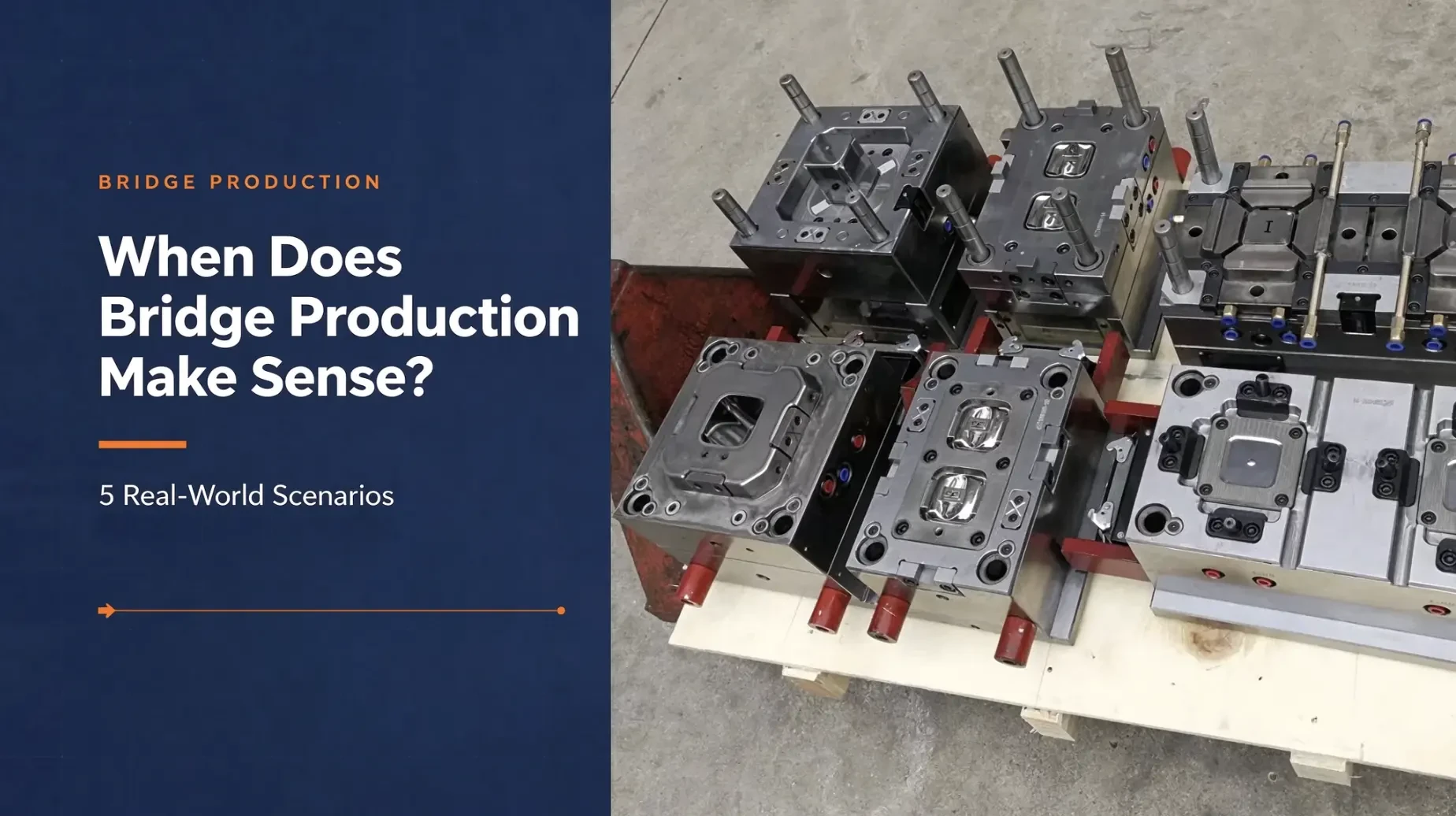
Bridge production is the answer when demand is unproven, tooling lead time threatens a launch, or the design is still moving. Five scenarios with real numbers, plus the conditions where a steel mold wins.
Your design is frozen, your launch date is set, and a $65,000 steel mold quote is sitting in your inbox. The only thing you don't have is proof that the market will buy 50,000 units.
Bridge production is the manufacturing answer to that gap — but it is not the answer to every gap. This guide lays out the five scenarios where bridge production makes sense, the numbers behind each one, and the conditions under which a production mold is the better call.
The short answer: bridge production makes sense when demand is unproven, when tooling lead time threatens your launch, when you only need a milestone batch, when the design is still moving, or when your production tool is exposed to supply-chain risk. It stops making sense once annual demand clears roughly 50,000 units, the design has been frozen for six-plus months, and the market is validated — at that point a $65,000 steel mold at about $0.80 per part wins.
What Bridge Production Is — and What It Buys You
Bridge production is the transitional manufacturing stage between prototype and mass production. It delivers production-grade parts in low-to-medium volumes — typically 100 to 10,000 units — using tooling that balances cost, speed and durability rather than optimizing for millions of cycles.
That definition matters because it separates bridge production from "cheap production." What you are actually buying is four business outcomes:
- Revenue during the transition. You can sell, ship and invoice before the production line is fully capitalized.
- Process validation before hard tooling. You prove the molding or MIM route works at production scale, not just in a lab.
- Real-world product feedback. Parts in customers' hands surface problems that no prototype review catches.
- Reduced financial risk with maintained momentum. You convert tooling risk into market evidence.
The comparison below shows what changes when you move from bridge tooling to a production tool:
| Dimension | Bridge tooling (P20) | Production tooling (hardened steel) |
|---|---|---|
| Tooling investment | About $8,500 | About $65,000 |
| Unit cost at 10,000 pieces | About $2.50 | About $0.80 |
| Total cost at 10,000 pieces | About $33,500 | About $73,000 |
| Lead time | 3–4 weeks | 8–10 weeks |
| Tool life | 15,000–25,000 cycles | Hundreds of thousands to millions of cycles |
| Best fit | 100–10,000 units | 50,000+ units per year |
Scenario 1: Launching Into Unconfirmed Demand
This is the classic case. The part is validated, the launch date is public, and the forecast is an educated guess. Signing a large tooling purchase order means betting the tooling budget that the guess is right.
A bridge mold changes the size of that bet: about $8,500 in tooling, production-grade parts in 3–4 weeks, and a total of roughly $33,500 at 10,000 units instead of $73,000. The parts are sellable, so the launch generates revenue while the demand signal accumulates.
How to run it. Set an explicit demand checkpoint before you start — six to twelve months of shipments, or your first 10,000 units. When the checkpoint clears, reinvest in steel. Until then, the roughly $1.70 per-part premium is the cost of not overbuilding capacity you may never need.
Scenario 2: Tooling Lead Time Threatens the Launch Date
Here demand is credible and the design is stable — the schedule is the problem. Some mold shops quote 8–12 weeks just to get started, and a production steel tool typically runs 8–10 weeks before the first part ships. If your market window is shorter than that, the tooling decision is already out of your hands.
Bridge tooling runs 3–4 weeks, which puts production-grade parts in your warehouse while the steel mold is still in design review. Run the two paths in parallel: release the bridge tool now, place the steel order at the same time, and switch over when steel comes online.
How to run it. Treat the bridge tool as a schedule buffer with a defined exit date, not as a permanent line. The moment steel is qualified, retire the bridge tool — its job was to protect the launch window, and it has done it.
Scenario 3: You Only Need a Milestone Batch
Not every program needs volume. A clinical trial needs 500 cleanroom-grade housings in 15 days. A customer evaluation needs 200 units. A regulatory submission needs a documented lot, not a production run.
Rapid-prototype injection molding covers 50–1,000 units in 10–18 days; bridge tooling covers the 1,000–10,000 band at 3–4 weeks. In both cases you size the batch to the milestone rather than to a forecast, which keeps the tooling spend proportional to the decision you are actually making.
How to run it. Keep the material and process family identical to your intended production route so the validation data carries over. For regulated batches, confirm that process control, inspection and traceability cover the milestone — a fast batch that cannot be documented is not a shortcut, it is a delay with extra steps.
Scenario 4: The Design Is Still Moving
Post-launch feedback arrives, a wall thickness needs adjusting, a gate location is causing cosmetic rejects. Against a hardened steel mold, every one of those changes is expensive and slow; against bridge tooling, they are routine.
Aluminum bridge molds last 500–5,000 cycles, pre-hardened P20 lasts 15,000–25,000 cycles, and 3D-printed mold inserts iterate faster still. The economics favor bridge whenever the expected number of design changes is greater than one.
How to run it. Use bridge runs to close the last open items — wall thickness, snap-fit engagement, gate location — and freeze the design before you cut steel. The goal is to arrive at the steel mold with a drawing that will not change for at least six months.
Scenario 5: A Supply-Chain Gap Is About to Break Your Timeline
A production tool is delayed by a supplier's capacity, a logistics disruption or a single-source failure, and the launch schedule is exposed. Waiting is not a strategy.
Bridge production gives you a second, schedulable path to production-grade parts: aluminum or P20 tooling, 3D-printed inserts, or CNC machining for simple geometries. It converts a single point of failure into a parallel route.
How to run it. Qualify the alternate route before you need it. A bridge tool that has never run your part is not a contingency plan — it is a second risk. First articles, dimensional reports and material certificates should exist before the disruption arrives.
When Bridge Production Does Not Make Sense
Bridge production stops being rational the moment the uncertainty it protects against disappears. Skip it when:
- Annual demand already exceeds 50,000 units and the design is frozen for six-plus months. A steel mold's much lower unit cost wins, and the higher tooling investment amortizes quickly.
- The geometry is simple. CNC machining delivers production-grade parts in 1–2 weeks with no tooling investment at all.
- You need only 1–100 units. 3D printing or CNC is faster and cheaper than building any mold.
- The part falls outside the moldable envelope. MIM is built for 0.1–100 g parts at ±0.02 mm; large parts and wrought specialty alloys belong to other processes.
- You need millions of parts within a quarter. Bridge tooling is rated in thousands of cycles, not millions — wear becomes the constraint, not cost.
The Cost Comparison at 10,000 Units
Numbers make the trade-off concrete. At 10,000 pieces, the four common routes land here. Figures are indicative and quoted per project:
| Process | Tooling cost | Unit cost | Total at 10,000 | Lead time |
|---|---|---|---|---|
| Bridge-tooled injection molding (P20) | $8,500 | $2.50 | $33,500 | 3–4 weeks |
| Production steel tooling | $65,000 | $0.80 | $73,000 | 8–10 weeks |
| 3D printing | None | $15 | $150,000 | 3–5 days |
| CNC machining | None | $8 | $80,000 | 1–2 weeks |
At this volume, bridge tooling costs about 46% of the production steel route — and it is the only route that combines a four-figure tooling outlay with production-grade parts. 3D printing and CNC avoid tooling entirely, but their unit costs make them uncompetitive once you pass a few thousand pieces. For the full breakdown, read bridge production economics and bridge mold versus production mold.
How to Decide in Five Questions
Before you sign either purchase order, answer these honestly:
- Is demand proven or assumed? Assumed points to bridge.
- Is the steel mold lead time inside your launch window? If not, bridge.
- Do you need full volume, or a milestone batch? A milestone points to rapid-prototype or bridge tooling.
- Is the design frozen for at least six months? If not, bridge.
- Is your production path exposed to a supply-chain event? If yes, bridge — and qualify the alternate route now.
Two or more "bridge" answers plus annual demand under roughly 50,000 units is a clear signal. Bridge production is not the cautious choice in that situation; it is the correct one.
Frequently Asked Questions
What is bridge production?
Bridge production is the manufacturing stage between prototype and mass production, typically covering 100–10,000 units. It delivers production-grade parts using transitional tooling that balances cost, speed and durability instead of optimizing for millions of cycles.
When should I use bridge production instead of a production mold?
Use bridge production when demand is unproven, tooling lead time threatens your launch date, you only need a milestone batch, the design is still changing, or your production tool is at supply-chain risk. Below roughly 50,000 units per year, bridge tooling usually wins on total cost.
How much does bridge tooling cost?
A pre-hardened P20 bridge mold costs about $8,500 and produces parts at roughly $2.50 each. At 10,000 units the total is about $33,500, against about $73,000 for a $65,000 steel mold at $0.80 per part.
How long does bridge production take?
Bridge tooling typically runs 3–4 weeks, compared with 8–10 weeks for a production steel mold. For smaller milestone batches, rapid-prototype injection molding delivers 50–1,000 units in 10–18 days.
How many parts can a bridge mold produce?
Aluminum bridge molds are rated for 500–5,000 cycles, pre-hardened P20 for 15,000–25,000 cycles. That comfortably covers the 100–10,000 unit band bridge production is designed for; if you need millions of parts, move to hardened steel.
When does bridge production stop making sense?
When annual demand clears about 50,000 units, the design has been stable for six-plus months, the market is validated, and capital for a production tool is available. At that point the production mold's lower unit cost wins on total spend.
Conclusion: Bridge Is a Stage, Not a Compromise
Bridge production makes sense when speed, evidence and cash matter more than unit cost, and it stops making sense the moment demand, design and volume are proven. The mistake is rarely choosing bridge — it is choosing it too late, or skipping it while the uncertainty is still there and betting the tooling budget on a forecast.
Not sure which scenario you are in? Send us your drawing, your volume forecast and your launch date — we will tell you whether bridge or steel is the right next step, and show you the total cost at your quantity. Haoding Precision provides contract manufacturing for MIM, precision injection molding, CNC machining and 3D printing, with ISO-aligned quality management and ±0.01 mm inspection.
Send your drawing for a bridge-versus-steel review
Related reading: how to choose a manufacturing process by quantity, what bridge production is and MIM vs CNC vs 3D printing.